Introduction
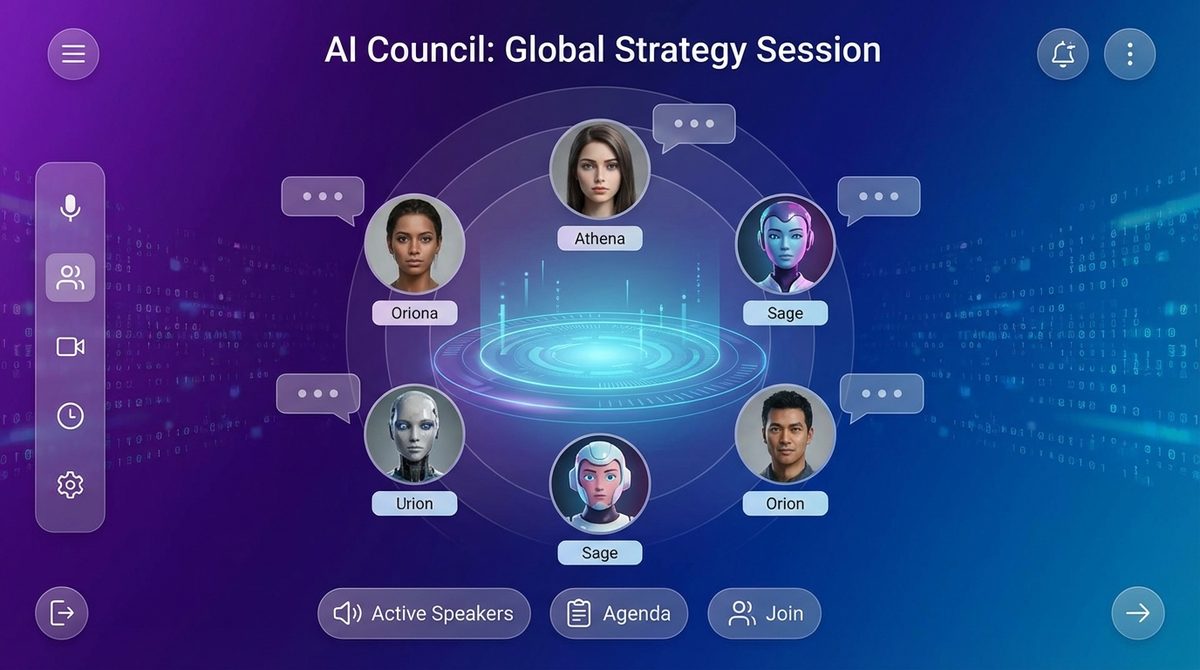
Imagine assembling a panel of the world's most advanced AI systems to answer your question. Not just ChatGPT, but also Claude, Gemini, DeepSeek, Llama, and a dozen more—all providing their perspectives on your query.
This is what an AI council does.
AI council applications query multiple frontier AI models simultaneously, presenting their responses together and synthesizing consensus. Instead of one AI's opinion, you get the collective intelligence of the entire AI industry.
---
What is an AI Council?
An AI council is an application that:
- Accepts your query through a single interface
- Sends it to multiple AI models (GPT-5, Claude, Gemini, DeepSeek, Llama, etc.)
- Collects responses from all models
- Presents them together for comparison
- Synthesizes insights showing agreement and disagreement
The Council Metaphor
In human organizations, councils bring together diverse expertise:
- Corporate boards combine financial, legal, and operational perspectives
- Medical boards include specialists from different fields
- Advisory committees gather experts with different backgrounds
---
Why Use an AI Council?
Problem: Single-Model Limitations
Every AI model has limitations:
- Training data gaps: No model knows everything
- Biases: Each reflects its training distribution
- Blind spots: Certain topics handled poorly
- Hallucinations: Confident errors that seem plausible
Solution: Council-Based Approach
An AI council addresses these through:
- Diverse coverage: Multiple training sets cover more
- Bias detection: Different biases cancel out
- Blind spot mitigation: Models complement each other
- Hallucination detection: Outliers become obvious
The Numbers
| Approach | Accuracy on Complex Questions | Hallucination Rate |
|---|---|---|
| Single model | ~75% | ~15% |
| Council (3 models) | ~85% | ~8% |
| Council (5+ models) | ~90% | ~4% |
How AI Councils Work
Step 1: Query Submission
You enter your question once. The system prepares it for distribution to multiple models.
Step 2: Parallel Processing
Your query goes to all selected models simultaneously. There's no waiting for one model before querying another—everything happens in parallel.
Step 3: Response Collection
Responses stream in from each model as they complete. You can see them arriving in real-time.
Step 4: Multi-Round Discussion (Optional)
In advanced councils, models can respond to each other:
- Model A sees Model B's response
- Model A adds nuance: "I agree with the first point, but would add..."
- This creates genuine dialogue between AI systems
Step 5: Consensus Analysis
The system synthesizes responses into:
- Points of Agreement: Where all models align
- Points of Disagreement: Where perspectives differ
- Confidence Score: Based on agreement level
- Final Synthesis: Comprehensive answer incorporating all perspectives
AI Council Features
Multi-Model Selection
Choose which AI systems to include:
- OpenAI: GPT-5, GPT-4o, GPT-4 Turbo
- Anthropic: Claude Opus, Claude Sonnet
- Google: Gemini Ultra, Gemini Pro
- Meta/Groq: Llama 3.2, Llama 3.1
- DeepSeek: DeepSeek R1, DeepSeek Chat
- Others: Mistral, Qwen, and more
Discussion Rounds
Configure how many rounds of inter-model discussion:
- 0 rounds: Simple parallel responses
- 1-2 rounds: Basic discussion and refinement
- 3-5 rounds: Deep exploration of nuances
Consensus Synthesis
Automated analysis including:
- Overview summarizing key themes
- Explicit agreement points
- Explicit disagreement points
- Final verdict with recommendations
- Confidence percentage
Export Options
Download complete council sessions:
- PDF for documentation
- Markdown for further editing
- Copy individual responses
Use Cases for AI Councils
Research Questions
Example: "What are the long-term effects of AI on employment?" Why council works: Different models have different data and perspectives on this contested topic. Seeing their agreement and disagreement helps understand the actual state of knowledge.Business Decisions
Example: "Should we expand internationally or focus domestically?" Why council works: Strategic questions have multiple valid answers depending on context. A council surfaces different frameworks and considerations.Technical Architecture
Example: "What's the best approach for real-time data synchronization?" Why council works: Technical problems often have multiple solutions. Different models suggest different approaches, and their agreement points indicate industry best practices.Complex Analysis
Example: "Analyze the competitive landscape for AI writing tools" Why council works: Each model has different coverage of the market. Together, they provide more comprehensive analysis than any single model.Important Decisions
Example: "Should I accept this job offer?" Why council works: Life decisions benefit from multiple perspectives. Seeing where AI models agree (and disagree) helps identify the key factors to consider.---
AI Council vs. Single Model
| Aspect | Single Model | AI Council |
|---|---|---|
| Perspectives | 1 | 15+ |
| Time | 5-30 seconds | 30-60 seconds |
| Error detection | None | Cross-validation |
| Confidence | Assumed | Quantified |
| Nuance | Limited | Comprehensive |
| Cost per answer | $0.01-0.10 | $0.05-0.50 |
| Value for important questions | Moderate | High |
When to Use Single Model
- Casual questions
- Quick lookups
- Speed-critical applications
- Low-stakes queries
When to Use AI Council
- Important decisions
- Research questions
- Complex analysis
- Anything where accuracy matters
The Best AI Council App: CouncilMind
Overview
CouncilMind is a purpose-built AI council application offering:- 15+ frontier models from 5+ providers
- Multi-round discussions (0-5 rounds)
- Automated consensus synthesis
- Confidence scoring
- PDF/markdown export
Key Features
Model Selection Choose from GPT-5, Claude Opus, Gemini Ultra, DeepSeek R1, Llama 3.2, and more. Select specific models or use "all" for maximum diversity. Discussion Rounds Enable AI models to respond to each other. Watch nuances emerge as they refine positions through dialogue. Consensus Analysis Get clear breakdown of:- What models agree on
- What they disagree about
- Overall confidence level
- Synthesized recommendation
- Save all council sessions
- Export to PDF for documentation
- Search past sessions
- Organize by topic
Pricing
- Free: 5 council queries (no credit card)
- Starter ($9/mo): 1000 queries, all models
- Pro ($29/mo): Unlimited queries, all models
Getting Started with AI Councils
Step 1: Sign Up
Create a free CouncilMind account. No credit card required for the free tier.
Step 2: Enter Your First Query
Ask something important—a question where accuracy matters.
Step 3: Configure Settings
Choose:
- Which models to include (recommend all for first query)
- How many discussion rounds (recommend 2)
Step 4: Review Results
See:
- All model responses
- Their discussion with each other
- Synthesized consensus
- Confidence score
Step 5: Make Better Decisions
Use the council's insights to inform your decision with more confidence than any single AI could provide.
---
The Future of AI Councils
Emerging Capabilities
Smarter Routing: Automatic selection of relevant models per query Domain Specialists: Pre-built councils for legal, medical, technical domains Real-Time Councils: Faster processing for interactive use Persistent Councils: Ongoing model collaboration on extended projectsWhy This Matters
As AI becomes more powerful and more integrated into decision-making, the limitations of single-model approaches become more costly. AI councils provide:
- Error reduction through consensus
- Comprehensive perspectives
- Quantified confidence
- Protection against single-model failures
---
Conclusion
An AI council transforms how you interact with AI—from asking one system and hoping for the best to convening a panel of the world's most advanced AI models and getting their collective insights.
For any question that matters:
- One opinion isn't enough
- Multiple perspectives reveal nuance
- Consensus indicates reliability
- Disagreement signals complexity
---
Frequently Asked Questions
What is an AI council app?
An AI council app queries multiple AI models simultaneously (GPT-5, Claude, Gemini, etc.) and presents their responses together with consensus analysis. It's like assembling a panel of AI experts for your questions.
How many AI models should I query?
For comprehensive coverage, 5+ models from different providers works well. CouncilMind includes 15+ models by default, providing diverse perspectives from all major AI labs.
Is an AI council more reliable than ChatGPT alone?
Yes. When multiple models agree, you can trust the answer more. When they disagree, you know the topic is complex. Either way, you gain information you wouldn't get from a single model.
> Related: AI Consensus Tool Guide | Multi-Model AI Explained | ChatGPT Alternatives